 |
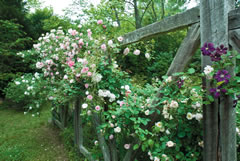
| Emmy Morrison found this rose, Call Down the
Storm, at a deteriorating old house at what is
now exit 25 of I-77 before the highway was built
and rooted cuttings. |
| |
 |
| Emmy Morrison with Paul Neyron. |
| |
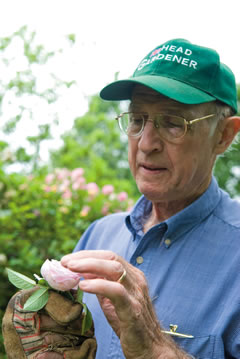 |
| Bill Morrison shows off Clotilde
Soupert. | |
Emmy “Rose” Morrison can look into each
pink face and tell you what it’s been up to for several
hundred years – the famous people it has known and the
adventures it has seen. Her pink faces and many other
shades; belong to heirloom roses, and Emmy knows them,
every one. She points out that before the introduction
of modern hybrids, most of which have very little scent,
roses were not red, but a deep pink.
“I’ll tell you how long I’ve loved old roses,” Emmy
says. “Since when I was riding a tricycle, that’s when –
and I’m 78 years old,” she finishes from her Davidson
patio overlooking about an acre of exuberant bloom.
There are so many varieties out there – more than 100 –
that, frankly, she’s lost count.
Emmy grew up in Concord, and while tricycling one
day, she saw a rose in a neighbor’s yard that captivated
her. She couldn’t forget it. As a young bride 55 years
ago, she went back to the house to see whether the rose
was still there. “The owner gave me a cutting, and I
still have it today. Charles De Mills is the name of it.
It is pre-1700,” she says of the rose’s historical
origins.
The fact that each petal of an heirloom rose bursts
with history is a big reason people love them. Avid
collectors such as Emmy are on a kind of quest to grow
them, tell people about them and share them in order to
preserve them. Emmy says only several hundred out of
thousands of old rose varieties still exist. And they
survive only because collectors grow them.
Heirloom roses – smelling fragrant the way modern
varieties often don’t – fell out of fashion after the
introduction of tea roses in 1867. Too bad, because
unlike fastidious modern hybrids, they require little or
no pesticides or fungicides. Environmentally friendly,
they thrive in average soils.
“You know how modern tea roses have a reputation for
requiring fastidious attention and spraying or they’ll
fall over in a faint?” she asks. “What I love is that
most heirlooms are so tough. They’re great for beginners
to grow. That means it’s easy to get other people hooked
on this hobby.”
She admits to feeding them once a year with her own
concoction and once in a while spraying for Japanese
beetles. But that’s it.
She points out a lovely one called Old Blush – the
rose that was blooming at Appomattox – one of her
favorites. “But then my favorite is whichever one I’m
looking at now,” she says with a smile.
And this time of year, with May as the prime blooming
season, she and her husband have plenty of favorites to
behold.
Collaborative gardenin
“I
couldn’t do it without this man here,” Emmy says of her
husband, Bill – known as “Bud” – who does the heavy
labor. Bill has just stepped off the riding mower. He’s
been working on the parallel runways of lawn meant for
strolling between long, raised beds of roses that have
no respect for lawn.
It’s a strange sight to look out past the rose beds
and see some of the roses that have escaped and are
climbing 35 to 40 feet into the branches of trees at the
back of the property. “We put those climbers back there
temporarily, till we could figure out what to do with
them,” she says wryly, looking up at the roses that have
happily taken over the treetops.
Bill is wearing heavy-duty canvas gloves up to his
elbows, called “rose sleeves,” so he doesn’t get
scratched as he mows past roses that are leaping with
blooms and thorn-laden stems. He holds a hiking stick on
his lap to push back the many runners full of thorns
that spill over onto the lawn.
“I am fortunate to have a husband who loves this
hobby as much as I do,” Emmy says.
Bill and Emmy, who met at a square dance more than 55
years ago, moved to Davidson from Cabarrus County about
15 years ago. They say it took five years to do all the
digging and plant all the roses. They started with 15
roses that they transplanted from their Cabarrus farm,
and their rose garden took off from there.
Bill remembers this particular stretch of land well.
He was raised just a few miles away. “I remember when
they used to grow cotton all through here,” he says.
“They were still bringing the mail by horse and buggy
when I was a boy.
Secrets of acquisition
The
Morrisons usually collect their roses through a method
known as “rose rustling.” There are Web sites devoted
entirely to discussions of this pastime and its
etiquette.
“That’s when you get cuttings from roses that you
spot in old churchyards and fields, and hope there are
no snakes,” Emmy says. “Of course, if it’s someone’s
house, you always ask first.”
Emmy says rose rustling equipment consists of boots
for tramping through tall grass, a cooler, paper towels
and pruners for cutting a piece of the rose you are
collecting. Moisten a paper towel and wrap around the
cut end for transport in the cooler.
Once home, you root the cuttings to make a clone of
the original. Not all your cuttings are going to take
and form roots in the normal course of things.
“To make a cutting, I split the leaf in half, strip
all but the hardwood, scrape the end down to where it’s
green, split the butt end of it and put it in sand. I
sometimes dip the end in rooting hormone,” she says. “In
a group of 10 cuttings, you’d be lucky to get two or
three to root. Depends on the rose.”
Bill has taken off again on his riding mower. Every
once in a while, you can see the tip of his hiking stick
lift, and a cascade of blooms lifts gently as if in a
sweet smelling breeze.
The Morrisons’ Etiquette of Rose
Rustling
1. Always ask first. Unless you are
at a remote site, such as along a roadside, with no
signs of human habitation, you should always ask before
you snip.
2. Explain what you are doing.
Identify yourself and explain why you would like to have
some cuttings. It puts people at ease if you let them
know who you are, what you are doing and how much you
love roses.
3. Take photos and make notes. Ask
permission to take pictures of the plant and the
flowers, and offer to send a copy of the pictures to the
owner. Also make notes about the plant (preferably using
a found rose form of some sort). If you approach your
rose rustling in a serious and professional manner, it
will build the confidence of the owner that you are not
a criminal and that you are not involved in some sort of
scam. Also, the pictures and notes will help you
document and identify the cuttings.
4. Be friendly and share information.
You may know more about roses than the owner of
the plant, and the information that you can offer
usually will be accepted as a fair exchange for the
cuttings.
5. Express your gratitude. Thank the
owner for his or her generosity. It also doesn’t hurt to
send a nice note later.
6. Offer something in exchange. It
is nice to offer a small rooted cutting as a gift to a
generous plant owner, and it pays off in goodwill. A few
extra cuttings in 4-inch pots do not cost an experienced
rose rustler anything but a little time and effort.
7. Leave before they begin to think you are
going to stay for dinner.
FOR MORE INFORMATION
The
Morrisons’ garden is not public. But check out their
informative Web site for more information:
www.rkdn.org/roses/
The Morrisons have a collection of more than 100
kinds of heirloom roses, dating from before the 1600s.
Here are a few of Emmy Morrison’s top picks:
- Apothecary (the Red Rose of Lancaster – pre-1600s)
- Common Moss (1696)
- Old Blush (1752)
- Alba Maxima (the famous White Rose of York –
ancient)
- Charles de Mills (pre-1700s)
- Enfant de France (1860)
- Cardinal de Richelieu (pre-1847)
- Paul Neyron (1869)
- Crepuscule (1904)
Emmy’s Reading Choice:
“In Search
of Lost Roses,” by Thomas Christopher
Emmy’s Favorite Online Catalog of
Heirlooms:
Antique Rose
Emporium
www.weareroses.com
800-441-0002
BACK

| 


